
Hope Anchors the Soul Free SVG
Are you looking for a Free Inspirational Quote SVG?
This post may contain affiliate links. As an Amazon Associate, I earn from qualifying purchases. Please see my privacy policy for full details.

This Beautiful Anchor SVG is Perfect for Your Next Project
This free, easy-to-use hope SVG file is a great way to remind yourself that you can do anything you set your mind to. With this Hope Anchors the Soul SVG, you can create t-shirts, a reverse canvas project, or cut it out and use it on any number of projects like sublimation, waterslide paper, and printable vinyl!
Free Religious SVG
This inspirational hope SVG was the perfect quote choice for this week’s freebie. When I saw it, I immediately knew it would be perfect for adding to the anchor SVG I had ready to go this week! Sometimes the perfect quote lands in front of your eyes at just the right time.
What will you make with your Free Anchor SVG?
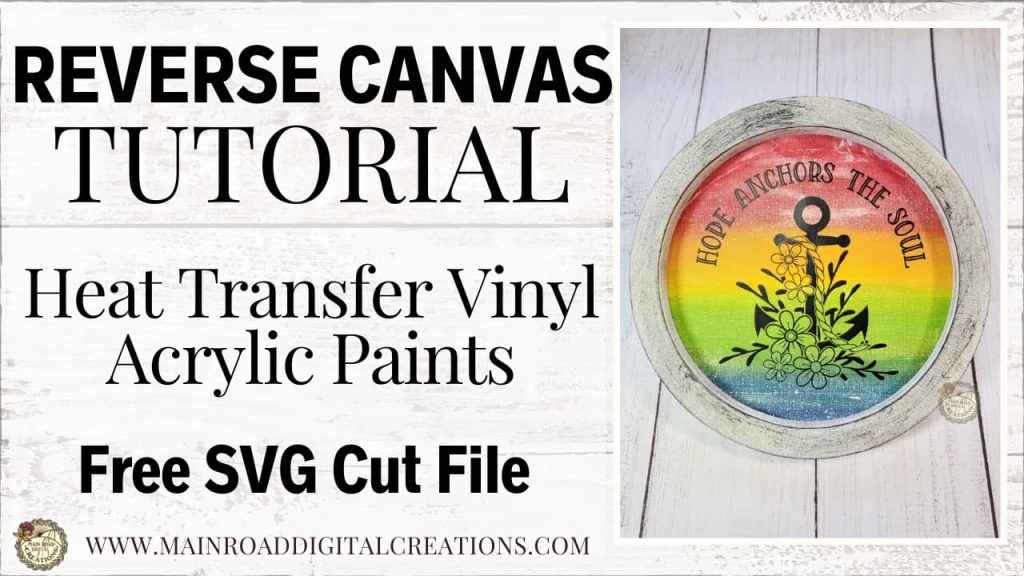
Add your favorite adhesive vinyl to a chalkboard sign, or use this week’s free SVG with heat transfer vinyl (HTV) to make a reverse canvas project like the painted rainbow canvas shown below. It’s a great way to add color and inspiration to your home decor!

What’s that font?
The font I used for this design is called Choco Cookies.

Reverse Canvas Craft Tutorial
Don’t you love it when you get an idea in your head, and it works out!? I found these circle canvases last week and couldn’t stop thinking about what I could make with them. I had the anchor SVG designed and found a hope quote that went perfectly with it, but now what to put it on? It all came together when I got the idea to paint the canvas. To be honest, I wasn’t sure it would work because I’ve never tried to paint a canvas before and then apply heat transfer vinyl (HTV). So I did a test with a smaller canvas, and it came out perfect!
How to Make a Reverse Canvas Sign
See exactly how I created this beautiful reverse canvas in my video tutorial, or keep scrolling if you prefer written step-by-step instructions.
Supplies Needed for Your Reverse Canvas Project
- Acrylic Paints – I purchased this set last month and love it! It comes with 24 bottles of FolkArt Paint and paintbrushes. The colors I used are:
- Cardinal Red, Daffodil Yellow, Lime Green, True Blue, Violet Pansy, White, Black
- Paintbrushes
- Chip wood paintbrush
- Plastic Paint Palettes from Dollar Tree- you can use a paper plate or whatever you have on hand
- Brayer
- Spray Adhesive– my can says Craft Bond Extra Strength
- Chipboard
- Craft Knife, Staple Remover, Pliers
- Heat Transfer Vinyl
- Cutting Mat
- Cutting Machine – I have the Cricut Explore Air 2
- Heat Press-or another device to apply heat transfer vinyl
- Pressing Pillow
- Teflon Sheet
- Weeding Tools
- Pin Pen – Weeding Ring
- Other items to have on hand -Gloves, Paper Towels, Painters Tape, Water
- 10″ Circle Canvas-I found mine at Five Below.
Dollar Tree Stretched Canvas
This was my test project. To be honest, I wasn’t sure if this project would work. I used a 6 x 8-inch stretched canvas from Dollar Tree. After applying the HTV to my canvas and seeing that my idea worked, I ran to my husband to show him. I was jumping up and down like a little kid who found free candy, haha.

Step by Step instructions on how to make a Reverse Canvas
Cricut Design Space-Free Anchor SVG
Measure your canvas so you know what size to make your design. Be sure to get the outside and the inside diameter.
I used Cricut Design Space to upload the free SVG and resize it, but this is the same process in most cutting software.


Bring in a shape to represent your canvas; I used a circle because my canvas is round. This is where you will need to add in the dimensions of your canvas that you took earlier. I used 3 circles: one to represent the outside of my canvas, the inside ring, and the area where I wanted to add my design.
Ungroup all the elements of your free SVG cut file. Hide the color from the rope and the flowers because you won’t need them. Click on the anchor and change the color to black, then highlight your entire project and weld it together. Move your design and resize it to fit in the area of the shape where your completed design will be. Hide or delete the shape (circles) because you don’t want to cut them. They are just for sizing purposes.


Heat Transfer Vinyl (HTV)
Remember to mirror your design before cutting it if you use heat transfer vinyl (HTV). When applying your HTV to your mat, use a brayer to help adhere your vinyl. This helps with getting a smoother cut and for the designs that may have tinier pieces. Also, remember the shiny side goes down when you apply your vinyl to your mat. Double-check that you have mirrored your design in the design space. Set your machine to iron on and click that button.


Weeding your Vinyl
When you weed your vinyl, always remember to pull it up slowly, even when using HTV. Heat transfer vinyl is typically easier to weed than adhesive vinyl, but you should still go slow as you pull the vinyl away from the carrier sheet.


I’m wearing a wedding ring and using a pin pen for this project. The pin pen is probably my favorite weeding tool! It makes the job of weeding vinyl so much easier.


Removing the Canvas from the Frame
I believe the frame under this canvas is made from particleboard. I first started by using a crafting knife to slice the canvas all the way around the frame. I had to use a bit more pressure than I normally do with the wooden frames; the blade didn’t penetrate the frame as easily as it did with wood.


Then I slipped a pair of scissors inside the canvas to help cut around the staples and release it from the frame.


Painting the Canvas with Acrylic Paints
After you remove your canvas from the frame, flatten it by smoothing it with your hands to make it easier to paint. I’m a sloppy painter, so I added a piece of cardstock under my project to try to prevent a mess.


Add your paint colors to a tray, a plate, or whatever works for you. I added a bit of water as I went just to help with the application process. Have a couple of paintbrushes handy- this is for painting as well as to help with the blending as you paint. If you have difficulty getting the paint to spread, dip your brush in a small amount of water. Acrylic paints can be thick.
You’ll see I overlapped some of the colors to get them to blend, but I also went back and added more paint at times too. Paint with your heart; it’s whatever looks good to you!


Sand the Painted Canvas
This part of the process is optional. Once your canvas is dry, you can go over it with a sanding block or a piece of sandpaper to dull your colors. I like the distressed look, so I sanded mine pretty well to remove the bright colors.
Be sure to wipe down your canvas after you are done sanding to remove any particles. The particles will show under your vinyl once you press. I used a dry paper towel to wipe my canvas down.


Remove the Excess Canvas from the Frame
I will be honest and tell you removing the canvas from the back of this frame was not a fun time. I started by cutting the extra pieces off from around the staples with scissors and then went after them with my staple remover and pliers.


Removing the staples was necessary to get a flat surface to help adhere the canvas to the chipboard and frame. You can see by my thumbs down that I was not a fan of this part of the project haha.


Painting the Frame
I painted the frame with white acrylic paint. Add a bit of water if you need to to help your paint apply easier. Of course, I forgot to put gloves on when I painted the white and made a mess. Haha. Oh, the life of a messy crafter. I really am trying to get better at the messy thing. Haha. Look at those hands!


After the white paint dried, I applied a dry brush of black paint. AND I remembered the gloves this time! Yay! Drybrush is a technique where you dip your brush in the paint and then wipe the brush onto a paper towel to remove the paint from your brush. You don’t need water for this method. Don’t be afraid to take off a lot of the paint. You can always go back and add more if you need to.


Leaving just enough paint on your brush, you lightly run the paintbrush on your project to brush on the color. Remember, starting with just a small amount is better – you can always add more if you want the coverage to be darker.


Once your frame has dried, you can sand the frame if you like. This will give it a more distressed look.


Adding Heat Transfer Vinyl to the Canvas
Grab your dry frame, painted canvas, and your weeded project. I cut the carrier sheet down small enough to fit inside my frame so I could get a better visual of how my completed project would look. After deciding where it looks best on your canvas, head over to your heat press- or whatever heat source you use.


I’m using Siser EasyWeed vinyl, so my heat press is at 305 degrees. Be sure to use your Teflon sheet; I have mine attached to the top of my press with magnets. I am using a pressing pillow under my project; this helps your vinyl adhere better to your project, especially if there are any seams.
Follow your manufacturer’s recommendations on time and temperature for the vinyl you are using. My vinyl calls for 10-15 seconds at 305 degrees with a warm peel.


Cutting the Canvas to Size
Lay your frame over your canvas with your design centered where you like it. I used a pencil to mark on the canvas where to cut and then cut off the excess canvas following the pencil mark. After you cut the canvas, you may need to trim a bit more if you have any hanging over.


Cutting and Applying the Chipboard
The chipboard I used is square; they may have round chipboard, but I used what I had on hand. Use a pencil to trace the inside of the frame, then cut a little outside that line. Looking back, I probably could have traced the outside of the frame instead, but this worked too.


Now lay it all together to be sure it’s all going to sit correctly and line up nicely. Obviously, my backing doesn’t fit the entire frame, but as long as it’s behind the canvas and still able to stick to the frame (whether you use staples or glue), that’s all that matters.
I’m using painter’s tape and the hinge method on my canvas. This makes it easier to apply the adhesive spray and then adhere it to my backing. Apply one side of the tape to the canvas and one side of the tape to the chipboard so it opens like a hinge- then you spray your canvas with the adhesive spray.


Apply the spray in a well-ventilated area. I use a cardboard box in my basement. You won’t need a lot- just a small amount to lightly cover the canvas. Once applied, carefully lay your canvas on the chipboard backing using that hinge method. Then use a brayer to help push down the canvas onto your chipboard. Pull off the tape and trim your project if needed.


Applying the Frame to the Canvas
I am not great when it comes to using a staple gun with my reverse canvas projects. I always seem to miss the frame and send a staple through the canvas. No matter how well I line things up. So I wanted to try the adhesive spray on the frame to see if it would hold. I sprayed a very small amount onto the frame back over the trash can and then laid it carefully on my canvas. It stuck great! (Be careful not to get the spray on your hands…it’s very sticky…ask me how I know haha.) I wiped off any excess spray with a paper towel.


And there you have it! A reverse canvas project with a rainbow background! After looking at my finished project, I added a bit more red to the area above the writing. I am in love with how this came out, and I hope you love it too!
Please share your finished projects in our Facebook Group! I love seeing them!
Change the colors of your Free Anchor SVG for printable designs.
One of my favorite things is playing with a design’s colors. If I’m using vinyl, I can change the look in Cricut Design Space to get a visual of how it will look when I cut it from adhesive vinyl or heat transfer vinyl (HTV). Using the free SVG in your software allows you to change the colors and make it into a printable design. Whether you decide to use sublimation, printable vinyl, waterslide paper, or maybe make a card, the versatility of changing colors to fit your style is one of my favorite things about being a crafter.


All of the Free Files on my website are for Personal and Commercial use. Check out my Terms of Use (TOU) here.

I’d love it if you could take a moment to pin the Free SVG image above to Pinterest. By sharing, you’re helping my business grow, which allows me to keep bringing you the free SVG files you adore. Thanks a bunch for your support. It means the world to me!
Here’s where you can find your Free SVG Download
Design #107-Hope Anchors the Soul SVG cut file available in my freebie library. Get the password by clicking the button below and Joining our Freebie Club!
If you enjoyed this week’s free religious SVG, here’s another you may love!

Check out my shop for fun and creative designs!

Join the Creative Fabrica Membership

Fonts, designs, and so much crafty goodness! Over 16 million digital files are waiting! In partnership with Main Road Digital Creations, your first 10 downloads are totally free. After that? It’s just $47 a year (yep, that’s $3.99/month) with full commercial and POD use included. Sign up for Free!
Love it.
I’m so happy to hear you love it! Thank you for your comment. Happy Crafting, Janet!😊